
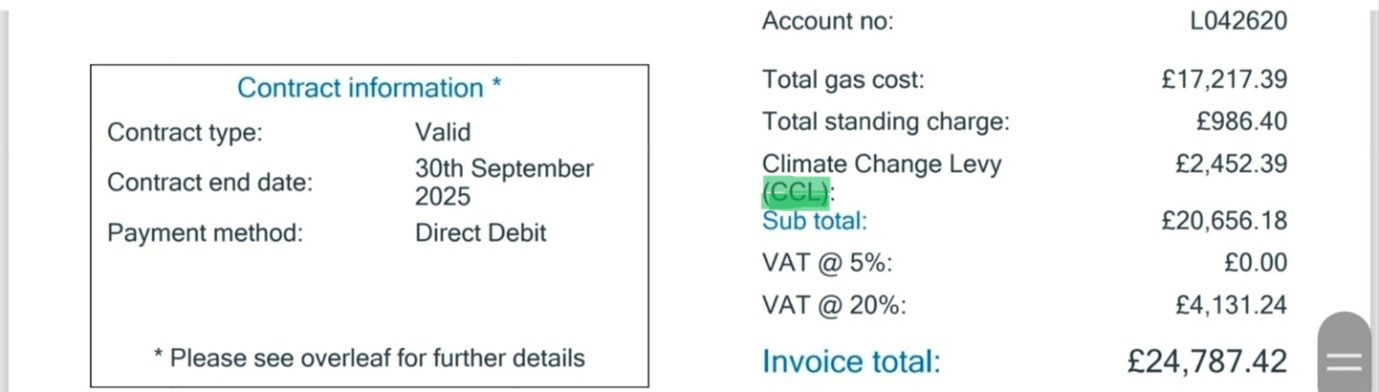
Climate Change Levy Review

Send us a bill. We’ll tell you if you’re owed money.

There’s a charge on your energy bill called Climate Change Levy. Suppliers add it by default. Unless someone sets up the right exemptions, it stays there. Month after month. Year after year.

Finding out whether it applies to you is simpler than you’d think.

how to find out

We’ll review it, check whether CCL should apply to your organisation, and come back to you with a clear answer. If there’s nothing to reclaim, we’ll tell you. If there is, we’ll explain exactly what’s involved and you can decide whether to go ahead.

No commitment. No cost. No four-hour procurement meeting. Just a bill and a conversation.

Send us a recent energy bill

That’s it

Who qualifies for CCL exemption or relief?

Eligibility depends on how energy is used. The most common qualifying categories are below.

Want the detailed qualifying criteria?

If you’d prefer to check the detail before speaking to us, you can browse the full qualifying criteria by clicking the link below. We’ve listed the mineralogical processes, metallurgical processes, and qualifying energy uses so you can see exactly where your organisation might fit.

If you’re using energy in ovens, furnaces, curing lines, heat treatment, or transformation processes, you may qualify for exemption or significant reduction. This is common in metallurgical and mineralogical processes, metal forming, shaping and finishing, and heat treatment, coating and surface treatment.

If your energy is doing something to a product rather than just keeping the lights on, it’s worth checking.

Charities and not-for-profits are typically exempt from CCL on energy used for non-business charitable activity. For many organisations, that covers most or all of their energy use, which means they shouldn’t be paying CCL at all.

Where it gets complicated is on mixed-use sites, where charitable and commercial activity share the same building. Suppliers tend to apply CCL across the whole bill without separating the two. That’s where most of the overpayments we find come from. But even on mixed-use sites, the charitable portion should still be exempt.

We’ve seen hospices absorb thousands in unnecessary charges. Money that should have gone to patient care, staff, or frontline services. Nobody had questioned the bill because everyone assumed someone else already had.

Businesses may qualify through process-based exemptions or Climate Change Agreements where energy use meets defined criteria. Many organisations assume these only apply to very large operators. In practice, eligibility often extends further than people expect.

What happens after sending us your bill

If your review shows a claim is worth pursuing, we take it from there. We handle the HMRC forms, the supplier forms, the corrections, the follow-ups, and the conversations that go nowhere for forty-five minutes before someone transfers you to the wrong department.

Leave the hold music to us

You don’t need to change supplier or deal with HMRC directly. We manage the process with your existing supplier from start to finish. We walk you through what we need, and if you’re based in Lancashire or Greater Manchester, we’re happy to come to you.

For larger or more complex sites, we may recommend a detailed energy assessment. This carries an upfront cost, but we deduct half of it from any successful refund.

Ready to check?

Send us a recent bill. We’ll take it from there.

Frequently asked questions

No. CCL is a tax charged per unit of energy. Whether you should be paying it depends on how your energy is used, not just what type of organisation you are. Where the right exemptions haven’t been set up, overpayments happen. When they’re corrected, refunds follow. There’s no loophole or grey area. These are rules that haven’t been applied properly.

No. Many organisations should be paying reduced CCL or none at all, including charities, hospices, manufacturers, engineering businesses, and organisations using energy for qualifying industrial processes. Eligibility is based on how your energy is used, not just what sector you’re in.

Because CCL sits on energy bills, not tax returns. It falls outside standard accounting reviews, which is why it gets missed so often. It’s not that your accountant has done anything wrong. It’s that nobody in the chain has any reason to check.

Up to four years. Anything older is usually outside the reclaim window. Every month that passes without correction is money you won’t get back.

No. CCL is a tax issue, not a supply issue. We manage the reclaim with your existing supplier. If anyone tells you that you need to switch supplier to fix CCL, that should raise questions.

If we don’t find anything, you don’t pay anything. For commercial organisations, our fee is 35% of any recovered CCL covering the previous four years. For charities and not-for-profits, it’s 25%, because we think that’s the right thing to do. There’s no upfront cost for the review. Where a reclaim is successful, we also put the correct exemption in place for the following five years at no additional cost.

You could try. But it’s not a form and a phone call. It’s years of historic billing, HMRC criteria, supplier documentation, and then months of chasing your supplier until they process the correction. We do this every day. We know which suppliers drag their feet, which forms trip people up, and where the sticking points are. We’d rather spend our Tuesday afternoon on hold with your energy supplier than you spend yours.

Energy Support Solutions helps businesses save money by recovering CCL overpayments, correcting billing errors, and securing competitive energy contracts. We handle the checks and the paperwork, so our clients don’t have to.

Contact
Follow us

Copyright © 2026 Energy Support Solutions Ltd.

Company Number: 15809846. Vat number: 501445434. ADR Number: C35ENER137